



If you are in danger right now, call the SAPS on 10111 or the GBV Command Centre on 0800 428 428, which you can reach at any time. You do not need evidence to ask for help, and you should never stay in a dangerous situation to collect proof. This post is for readers who are safe enough to prepare, and for those who want to understand what the law looks at when someone applies for a protection order, opens a criminal case or starts divorce proceedings. Evidence helps the court understand what happened, but your own sworn account is the foundation of any application. The steps below explain which records matter most, how to keep them safe from the person who harms you, and which evidence gathering methods put you at risk and should be avoided.
Why Evidence Matters Under the Domestic Violence Act
The Domestic Violence Act 116 of 1998 gives you the right to apply to the magistrates’ court for a protection order against a person in a domestic relationship with you. That includes a spouse, a life partner, a former partner, a person you share or shared a home with, a parent of your child and certain family members. The Act defines domestic violence widely. It covers physical abuse, sexual abuse, emotional and verbal abuse, intimidation, harassment, stalking, damage to property, entering your home without your consent and economic abuse, such as withholding money or controlling your access to finances.
Courts decide these applications on the facts that you put before them, and your sworn statement describing what happened is the central document. Supporting evidence makes that statement stronger because it shows a pattern, confirms dates and details and answers the denials that an abusive partner often makes. A court can grant an interim protection order based on your sworn evidence before the other person responds, and the evidence you gather helps when the matter returns to court for a final order. You do not need a perfect file to apply. Start with what you have and add to it over time, because a short, honest and specific account with a few supporting documents is better than a long file that you never finish.
Keep a Record of Every Incident
A written record of incidents is one of the most useful forms of evidence you can create. Memory fades and stress blurs details, so write down what happened as soon as you can after each incident. Record the date, the time, the place and exactly what the person said and did, using their words as closely as you can remember them. Note any injuries, any damage to property, whether children or other people saw or heard the incident, and what happened afterwards, including whether you called anyone or left the home.
Keep the record factual. Write what happened rather than how you interpret it, and avoid exaggeration, because courts trust records that read as plain and consistent. If you can, record threats separately from physical incidents, since threats show intimidation even when no one is physically hurt. Date each entry on the day you write it. If you cannot keep a written diary safely, send yourself an email from a private account that your partner cannot open, or leave voice notes with a trusted friend or a counsellor. A record that a third party received at the time of the incident is often more persuasive than one you wrote months later.
You should also keep photographs. Photograph injuries as soon as they appear and again as they change, and include a clear shot of the area and a close up. Photograph damaged property, broken phones, torn clothes and any scene that shows what happened. Make sure your phone records the date and time of each picture, and keep the original files rather than editing them.
Preserve Messages, Calls and Online Contact
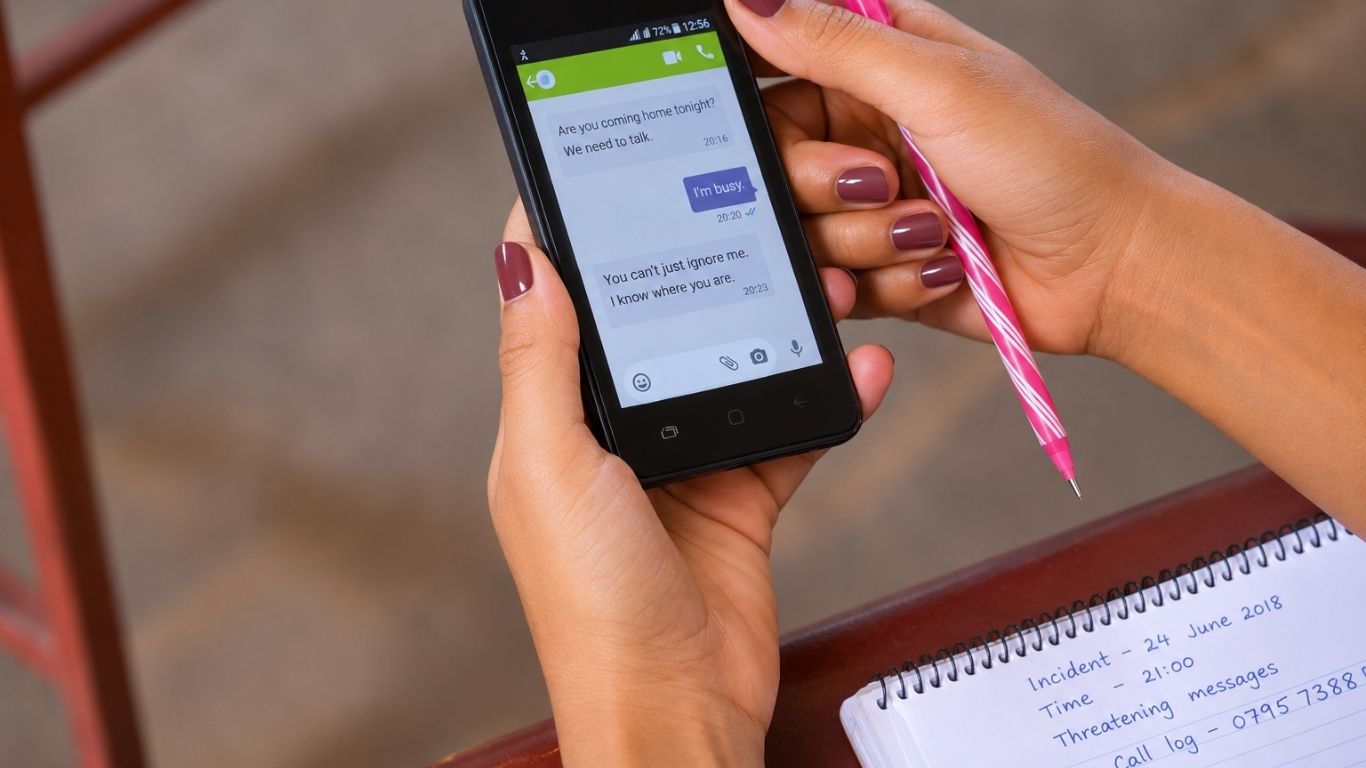
Messages often show threats, control and admissions in the abuser’s own words. Keep text messages, WhatsApp messages, emails, voice notes, social media messages and call logs that contain threats, insults, demands, apologies that admit what they did, or evidence of constant checking and monitoring. Do not delete anything, even if it is painful to read, because deleted messages are harder to prove and the court may question why they are missing.
Take screenshots that show the sender’s name or number, the date and the time, and make sure the screenshot shows the full conversation so the court can read the messages in context. Where possible, also export the full chat from the app, because an export shows the complete history. Save voicemails and voice notes in a second place. Back up everything to a secure location that your partner cannot reach, such as an email account with a new password that only you know, or a cloud account on a device that your partner has never used. Many abusive partners check phones, so assume that your device may be monitored and think carefully before you leave evidence in places that your partner can open.
If your partner sends you messages from different numbers or accounts after you have blocked them, keep those messages as well, because they can show harassment and stalking. If you are comfortable doing so, tell a trusted person where your evidence is stored, so that someone else can help you retrieve it if you lose access to your phone.
Medical Records and Professional Reports
If you are injured, visit a doctor, clinic or hospital as soon as it is safe to do so. Treatment matters first, and the medical record also becomes strong evidence. Tell the healthcare worker how you were injured and who injured you, because the record then shows both the injury and its cause. Ask for a copy of your records, a medical report or a hospital discharge summary, and keep any prescriptions, X rays or referral letters. If you report the incident to the police, they may refer you for a medical examination and a form that the doctor completes for the criminal case, and you should ask the officer to explain what happens with that document.
Medical evidence is not limited to physical injuries. If the abuse affects your mental health, see a psychologist, counsellor or social worker, and ask them to document your symptoms, such as anxiety, trouble sleeping, panic attacks or depression. Notes and reports from these professionals show the emotional and psychological effect of the abuse, which the Domestic Violence Act recognises as a form of domestic violence. Keep any employer records of sick leave, and any school records if your children show distress, because these documents show the wider effect on your household.
Report the abuse to the police and ask for a case number. A case number proves that you reported the incident on a specific date, and the police should give you a notice that explains your rights under the Domestic Violence Act. Keep both documents in a safe place, and write down the name and rank of the officer who helped you. If an officer refuses to open a case or discourages you from reporting, note the date and details, because you can lodge a complaint about poor service.
Financial Evidence of Economic Abuse
Economic abuse is often the hardest form of abuse to prove because it does not leave physical marks. It happens when someone controls your money, stops you from working, takes your salary, runs up debt in your name, refuses to pay for household needs or forces you to account for every cent. The evidence for economic abuse sits in documents, so start collecting them early.
Keep bank statements, payslips, credit card statements, loan agreements, proof of debts in your name that you did not agree to and any messages in which your partner refuses to give you money or demands that you hand over your income. Keep records that show you lost access to an account, that a card was cancelled or that your partner moved money without your permission. Keep proof of your regular household expenses, such as rent or bond payments, school fees, groceries and medical costs, because these show what your household needs and who has failed to provide for it. If your partner pays you maintenance and stops, keep a record of each missed payment.
You should also gather copies of important documents, including your identity document, passport, marriage certificate, children’s birth certificates, the lease or title deed and any policies or investment papers. If your partner hides or destroys these documents, a copy helps you replace them. Financial evidence matters beyond a protection order. If you divorce, a court assessing interim maintenance or spousal maintenance needs a clear picture of the household’s income and your needs, and our guide to spousal maintenance in South Africa explains how the court approaches that question.
Witnesses and Other Supporting Evidence
People who saw the abuse or saw its effects can support your account. These witnesses may include a friend who saw your injuries, a neighbour who heard shouting, a family member you told at the time, a colleague who noticed changes in your behaviour or a teacher who saw changes in your children. Write down their names and contact details and a short note of what they saw or heard, and ask whether they would be willing to give a statement if the court needs one. A statement from someone you confided in soon after an incident carries weight because it shows you reported the abuse at the time and not only after the relationship ended.
Keep records of previous protection orders, police reports, letters from shelters, counselling records and any complaints made to an employer or community leader. If your partner has a history of violence towards a previous partner, tell your attorney, because this information may be relevant. Do not approach these witnesses yourself in a way that alerts your partner. A discreet request, made at a safe time, protects you from a response that might escalate the danger.
Evidence Gathering Practices You Should Avoid
Your safety matters more than any piece of evidence. Do not confront your partner to get an admission, and do not provoke an argument to record it, because confrontation can trigger violence. Recording a conversation that you take part in is generally lawful in South Africa, but secretly recording your partner can escalate the situation if they find out, so speak to an attorney before you rely on this method and never record if you think the risk is high.
Do not access your partner’s phone, email, social media or bank accounts without permission, and do not install tracking or spy software on their device. These actions can break the law, including laws that deal with unlawful access to data and communications, and they can damage your own case and expose you to criminal liability. Do not take your partner’s property or documents in a way that creates a confrontation. If you need your own documents, such as your identity document or your children’s birth certificates, ask your attorney or the police for guidance on retrieving them safely.
Do not post about the abuse on social media or tell your partner that you are collecting evidence. A public post can alert your partner, can increase the danger and may lead to a defamation claim or to arguments that you exaggerated. Do not keep evidence on shared devices, in shared cloud accounts, in your car or in places your partner can search. Do not delay asking for help while you wait for more evidence. If the situation is dangerous, leave and seek protection first, and gather evidence later or with the help of a lawyer, a social worker or a police officer.

Keeping Your Evidence Safe
A well organised file is useless if your partner finds it. Choose a storage method that fits your situation. Options include a new email account with a strong password that you create on a public computer or a trusted friend’s device, a cloud folder on an account that your partner cannot access, printed copies kept with a friend, a family member, a colleague or your attorney, and copies stored at a shelter or support organisation if you work with one. Turn off automatic backups to any shared account, and check whether your partner can see your phone location, your photo albums or your app notifications.
Delete browsing history if it is safe to do so, but understand that a sudden change in your behaviour can alert an abusive partner. If clearing a history would look suspicious, use a private browsing window or a device that your partner cannot reach. Keep a short list of important phone numbers memorised or written somewhere hidden, including the police, a trusted person, your attorney and a shelter. If you plan to leave, pack a small bag with copies of your documents, medication, some cash, spare keys and basic items for your children, and keep it at a safe address.
How an Attorney Uses Your Evidence
An attorney turns your evidence into a clear and organised application. For a protection order, your attorney prepares your sworn statement, selects the evidence that supports each allegation and explains what to expect at the hearing. For a divorce, your attorney uses the same evidence to support applications for interim maintenance, a contribution to your legal costs and interim arrangements for your children, and to show the court why you need protection and stability while the case continues. In matters that involve children, the court always makes the best interests of the child the paramount consideration, and evidence that shows how the abuse affects the children carries real weight.
You do not need to arrive with a complete file. An attorney can help you identify what you already have, what you can safely add and what the court may ask for. If a police officer or a court official told you to go home and come back with more evidence, you can still apply, and an attorney can help you do it. Our team handles these matters with discretion, and we can arrange a consultation in a way that does not put you at risk.
Where to Get Help in South Africa
You can call the SAPS on 10111 in an emergency. The Gender Based Violence Command Centre runs a toll free helpline on 0800 428 428, and you can also send a Please Call Me request to 1207867# or SMS the word HELP to 31531. The Stop Gender Violence helpline is 0800 150 150, and the National Shelter Movement helpline is 0800 001 005. If you are a parent worried about a child, Childline is on 0800 055 555. These services are free, and they can connect you with counselling, shelters and legal support.
Frequently Asked Questions
What evidence do I need to get a protection order in South Africa?
You need a sworn statement that describes the abuse and shows that you are in a domestic relationship with the person. Supporting evidence, such as messages, photographs, medical records, a police case number and witness statements, strengthens your application, but you can apply without a full file and the court can grant an interim order based on your evidence.
Do I need to open a police case to apply for a protection order?
No. You can apply for a protection order at the magistrates’ court without opening a criminal case. You can also open a case if the abuse involves a crime, such as assault, and ask the police to explain your rights. A case number is useful evidence, but a protection order application is a separate process.
Should I take screenshots of abusive messages?
Yes. Take screenshots that show the sender’s name or number, the date and the time, and export the full chat if the app allows it. Do not delete the messages, and store copies in a safe place that your partner cannot access.
Can I record my partner without them knowing?
Recording a conversation in which you take part is generally lawful in South Africa, but it can create serious danger if your partner discovers it. Speak to an attorney before you rely on recordings, and never record if you believe it may provoke violence.
How do I prove financial abuse?
Keep bank statements, payslips, loan documents, proof of debts taken in your name, messages that show your partner refused to give you money or demanded your income, and records of household expenses that your partner failed to pay. An attorney can help you organise these documents and present them to the court.
What if I have no physical injuries?
The Domestic Violence Act recognises emotional, verbal, psychological and economic abuse, intimidation, harassment and stalking, so you do not need visible injuries to apply. A record of incidents, messages, counselling notes and witness accounts can support your case.
Is it safe to keep evidence on my phone?
It depends on whether your partner can access your phone or your accounts. Store backups in an account that only you can open, ask a trusted person to hold copies and think carefully before you keep sensitive material where your partner can find it.
What if I do not have any evidence yet?
Apply anyway if you need protection. Your sworn account is the starting point, and an attorney can help you identify evidence that you already have and what you can safely gather. Your safety comes before collecting proof.
You Do Not Have to Carry This Alone
Gathering evidence while you live with abuse is stressful, and the right support makes the process safer and clearer. Start with the records that you can keep safely, store them where your partner cannot reach them and ask for help early. At Shapiro & Haasbroek Attorneys, we have over 25 years of experience in family and matrimonial law across South Africa, including protection orders, divorce and arrangements for children where abuse is part of the picture. We work with clients across South Africa and travel where our clients need us. If you are ready to talk, contact us and we will arrange a confidential consultation that fits around your safety. If you are considering ending your marriage, our guide to divorce in South Africa explains what to expect from the process.